
My granddaughter tells me that many of her university classmates believe that mankind is living in the worst and most dangerous of times. Some of my friends have commented on a sense of building darkness and evil stirrings and asked my opinion. In the next two substacks I will offer my opinions. This first entry attempts to explain how I interpret the historical background of these stirrings and the second will offer my opinions of today’s events.
Before launching into this project, I need to explain the assumptions I bring to the analysis. Otherwise my comments will have no context and might give you cause for alarm.
Have we passed a historical inflection and are now racing down a dangerous slope towards disaster?
A passing knowledge of history reveals that the university students are wrong in their pessimism. When my grandfather woke up on September 11, 1939, he had to process the information that he would soon be sending his sons to war. He had lived through World War I, enjoyed a brief moment of sunshine in the Roaring Twenties, lost everything to drought and disease in the Dirty Thirties and now would be expected to deliver his children to the Canadian military. And he would know that, however reticent he might be to offer up his children, they would ignore him and join anyway. The next six years must have been very depressing and anxious for my and millions of other grandparents.
Or think of the Europeans living in 1349 who observed the movement of the Black Death, each week bringing it closer to their homes and knowing that, when it struck, you might be lucky and lose only a third of your village and family to a fast acting but horrible death.
Is our moment on earth uniquely difficult and bewildering?
I am a proponent of the 80-year cycle theory of William Strauss and Neil Howe. We are, using that formulation, in a fourth turning and will soon move from a time of trauma and transformation into a period of expansion and consolidation. We may be approaching the best of times.
It is common for every generation to believe that the time of their existence is the worst and most difficult with the fastest and most profound changes occurring. In the context of today, the age of the computer and artificial intelligence and rapid transportation and space exploration and cell phone convergence is bewildering and disruptive. But to call it the worst and most difficult is ungrounded cultural chauvinism.
Put yourself in Europe in 1494. With some practice you can now read the latest ideas in your own language and at a price you can afford. Books are showing up everywhere. You are hearing of ideas that blow your mind. And what about that guy who said he found a whole new world with brown people that spoke a strange language. He and his sailors just climbed in a boat and sailed west until they bumped into something. Imagine… we are not alone! In a few more years the largest and most important institution in the world would be shattered by the rantings of an unknown monk in a forgotten part of Germany. He took on God’s most holy institution, and millions were flocking to his message. Nothing would be the same again.
No, there have been times far more tumultuous than the ones we live in.
Has God abandoned us or is Jesus about to return?
I do not take a dispensational view of life under the sun. This means that I think the trajectory of human history is almost unbrokenly headed to the sunlit uplands. I can’t speak to the immanence of Christ’s return, but then no one can. What I am comfortable in saying is that God is in His heaven and things will work out. They always have, even if body counts have sometimes been unseemly high.
I think that we are witnessing a titanic clash of worldviews playing out in every sphere of human activity. However, I don’t ascribe particularly Luciferian motives to the games being played. Catastrophic worldview clashes have played out ever since Adam and Eve talked to a snake and Cain killed Abel. We are simply relearning the importance of worldview in determining the affairs of mankind.
Views strongly held result in actions that are consistent with those views and are not necessarily concocted in the pits of Hell. It is better to debate the worldviews than the actions stemming from them. Not all worldviews are benign or useful. Many are wrong and actively destructive. If we want to understand the forces playing out before us today, we need to know something of the worldviews which inform those forces.

Let me illustrate with an example. Many pundits place much of the blame for the darkness we feel on an entity called the City of London. This is the one square mile center of London’s financial district that that is a unique metropolitan corporation with its own governance structures, police force and laws. The Romans established it as Londinium, and it hosts the Bank of England, the London Stock Exchange and most of the largest financial corporations in the world. For this reason, it exerts enormous influence around the world and is guilty of bending a great many rules at the cost of untold numbers of lives to maintain its legal and financial hegemony. But not every action taken by the City of London is evil incarnate. Remember that it was London which financed the fifty-year fight to end the slave trade in most parts of the world and which stood alone in the lonely and frightening opening months of World War II.
What are the worldviews that are engaged in the current struggle to “rule the world”? I think there are two of them which will be described in mostly geopolitical terms.
Globalism
The globalist worldview is based on top-down management of the world through international social, cultural, and economic networks to optimize direction and speed of change. Globalism trades human dignity and creativity for the ability to provide rapid reaction and remediation when there are disruptions to the globalist plan. In economics this worldview endorses a mixture of mercantilism with free trade commerce that seeks to grow profit by reducing costs rather than creatively improving the product.
In the Canadian context, the purest expression of this worldview was articulated by Justin Trudeau who called Canada the first post national state and offered a glowing opinion of China due to its centralized and highly structured control systems which allow social norms and economic activity to be rapidly redirected. This view is shared by Mark Carney who goes further. He is consolidating power in his office by rarely consulting either his party caucus or Parliament prior to making head spinning announcements of actions that are, he says, favoured by Canadians based on undisclosed opinion polls.
Some assert that his stunning and inexplicable shifts in position are dictated by the globalist masters who control the City of London. Others speculate that maybe Mr. Carney has just never run a complex organization in the public sector and hates the idea of waiting on a slow-moving democracy. Maybe he doesn’t take the time to think through his pronouncements and misses the irony of preserving Canada’s sovereignty by giving it up to a low performing bureaucracy in Brussels.
In the international context, globalism was expressed best by Klaus Schwab and the World Economic Forum. He described a neoliberal global order operating in the context of an international rules-based system. He touted stakeholder capitalism, what some might call neofascism, as the best way to balance economic efficiency with socio-environmental responsibility and inclusive governance in the absence of national boundaries. It was never important to understand what this might mean other than that we would own nothing and be happy.
At its most elemental, the globalist project appears to be an elite-driven, Malthusian attempt to reduce the world’s population. Thomas Malthus was the first to predict a dire and rapidly approaching mass starvation attempt in 1798. In 1968, Paul Ehrlich predicted mass starvation in the 1970s. He tried again in 1974 predicting that a billion people would die by the mid 1980s.
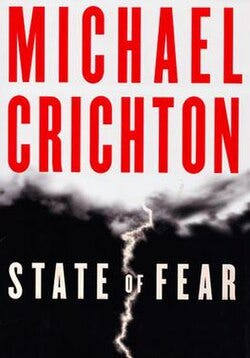
Michael Crichton in his 2004 book “State of Fear” argued that the population to be reduced must first be brought to a state of heightened fear. He noticed that the globalists rely on ever present crises to motivate reluctant populations to adopt the globalist worldview. First, it was global cooling, then global warming, then climate change, then a worldwide epidemic and now back to climate change. Absent a crisis, only a minority of people will opt for globalization and the depopulation program.
The globalist worldview has been around for a long time. The shift from a Roman republic to an empire was a move toward globalism. The establishment of the Holy Roman Empire with the coronation of Otto I in 962 was a move toward globalism. The imperial pretensions of 18th century England, based on their sea power and economic strength was a move toward globalism. When the more nationalistic Concert of Europe was finally destroyed by World War I, the League of Nations formed after the war was a globalist endeavour.
Nationalism or Sovereigntism
The sovereigntist worldview is based on acquiring and preserving national political, economic and cultural independence. It relies on what the Catholics call subsidiarity in which governance is best when it is administered as locally as possible. Freedom of individual action under an umbrella of public interest within a region of fixed boundaries is of paramount importance to the sovereigntist. There are no open borders in a nationalist dominant worldview. Sovereigntists don’t recognize supranational governance institutions such as the United Nations, the World Health Organization or the International Criminal Court. This was brought home very clearly by Javier Milei, President of Argentina in his recent address to the United Nations. After calling out the United Nations for its globalist worldview and unwillingness to fulfill its charter, Mr. Milei accused it of sowing fear saying, “fear of tomorrow is an excuse for limiting freedom today.”
Some argue that this worldview was first articulated in the 1648 Treaty of Westphalia, but that is a stretch. The treaty limits its remarks about nationalism to say that countries should not meddle in the internal affairs of other countries and any army crossing a national boundary without prior permission commits an act of war. Does anyone seriously believe that France and England were not nations prior to 1648?
The current swing towards sovereigntism in the world is evidenced by the re-election of Donald Trump and of nationalist presidents in Colombia, Ecuador, Peru, Bolivia, Chile and Argentina. The remarkable rise in the popularity of Alliance for Deutschland (AfD) in recent German elections and the rising popularity of Marine le Pen in France speak to a movement away from globalism and towards sovereigntism in those countries. Perhaps the longest lasting sovereigntist governments today are those in Russia and China. They may be accused of meddling in the affairs of other countries and cheating in trade, but they are not using globalist tactics or aligning with globalist agencies to take over the world.
Just as there have been periodic movements towards globalism in history so have there been movements toward nationalism. Certainly, the end of the 30 Years War and the 80 Years War in 1648 was a nationalist moment. Holland won its independence from Spain; Sweden was viewed as a for-real nation and the globalist Holy Roman Empire had is wings clipped. The end of the Napoleonic Wars was a remarkable nationalist moment as Spanish colonies won independence, the Holy Roman Empire was ended and Europe created a flexible concert process rather than a fixed Great Powers council. The end of World War II might have become a nationalist rather than a globalist moment had Franklyn Roosevelt not died when he did. In fact, the rapidity of his failing health and lack of an autopsy has spawned a great number of dodgy conspiracy theories suggesting he was killed to end the nationalist leanings of the US government.
In his remarkable memoir, “As He Saw It”, Elliot Churchill recounts the many conversations his father had with Winston Churchill. Elliot, who served as his father’s secretary, recalls that when Churchill pushed back at US reluctance to consolidate England’s hold over its colonies (primarily India), Roosevelt stated,
“I can’t believe that we can fight a war against fascist slavery, and at the same time not work to free people all over the world from a backward colonial policy.”
Roosevelt describes the most important worldview distinction between globalism and nationalism, and it is the one most often ignored. As previously stated, globalism trades human dignity and creativity for the efficiency of top-down management and control. Humans become cogs in machines created by overlord masters. Nationalism makes the opposite trade. Efficiency is traded for human dignity and creativity. Humans become free agents within boundary markers that define the public good. In a Biblical sense, one worldview accepts that all humans are created in the image of God and the other sees humans as drones of the state.
These are important distinctions when it comes to management of the economy.
Hamiltonian (American) System
When Shay’s Rebellion finally ended the original constitution of the United States (Articles of Confederation - 1781), it was decided to reconvene the Continental Congress to come up with a constitution that would work. The luminaries of the successful War of Independence agreed to attend giving hope that the short-lived experiment of “We, the People” might be saved. With help from Thomas Jefferson, Benjamin Franklin, and George Washington, a new constitution was written. It drew from a wide range of sources including Aristotle, the Roman Senate, the Bible and the many versions of the many constitutions written for the thirteen colonies. When the writing was over, Benjamin Franklin responded to a question that the United States was to become a republic – if the people could keep it. Not a strong vote of confidence.
Buried in the debate over the balance between federalism and state rights was a debate over the economic policies of the new country. Alexander Hamilton, Washington’s invaluable aide-de-camp from the war was a central figure in both the political and economic debates.
Hamilton argued that, however popular the economic theories of Adam Smith, they were inadequate to the new country as it sought to populate a continent. He argued that the powerful English economy would recolonize the United States and his solution was to impose tariffs on materials coming into the United States. The revenue from the tariffs would be used to pay off the war debts, build the necessary infrastructure and provide operating capital for the federal government.
One of the sharpest points of contention between Hamilton and Thomas Jefferson, his primary opponent, was that a national bank was not in the new constitution and, if created, would become a target of “crony capitalism”. Hamilton argued that such a bank was necessary to inflate the economy with the credit necessary to build the country. Hamilton won the argument and Jefferson came to agree with him.
The foundation of Hamilton’s argument was that a free people, made in the image of a creative God would build an ever-expanding economy. If the government provided infrastructure and capital and then got out of the way, the people would exploit the resources, create the industries, and market their products in ever increasing amounts generating sufficient private capital to return their loans and pay the taxes necessary to expand the economy.
His ideas were successful in the early years of the nation but arguments over the nature and activities of a national bank derailed the Hamiltonian System. It was resurrected by Abraham Lincoln who built a remarkable amount of infrastructure, including the first continental railroad, even as the country was embroiled in an expensive civil war. The economic scandals of the Grant presidency again derailed the Hamilton system and it wasn’t given prominence again until the presidency of William McKinley.
Globalist (British) System
Adam Smith’s groundbreaking economics textbook, “The Wealth of Nations”, published in 1776, was an argument against the prevailing mercantilist economic system of the British empire. Smith was sympathetic to the cause of the American colonists and their war of independence because of England’s “mercantilist delusion” which, in Smith’s view, was detrimental to the economies of both the colonists as well as of England. Smith argued for free trade between the new country and England and received support for that view from Thomas Jefferson and John Adams.
It was this free trade that Alexander Hamilton feared. Free trade is a “race to the bottom” as industries and economies constantly look to build at the lowest cost rather than with the greatest creativity. As it turned out, the views of Adam Smith were truncated by the mercantilist power of the East India Company whose business model was to use primary resources from the colonies to produce finished goods in England that would then be sold to the colonies and other markets. The free trade was limited to determining which colony could provide the raw materials at the lowest cost.
The free trade theories of Adam Smith were never realized in the English economy, and his theories were blunted further by the focus on production costs and class conflict introduced by David Ricardo. 19th century English economic policy was largely set by industrialists, and the most important industrialists were in the East India Company. The company was globalist, monopolist and almost fascist in its merger with the state. In fact, for much of the 19th century, the company supported a larger military force in India than did the British government.
The Great Game
It was this combination of industry and state with the power to make war that created what became the London System and this potent force was used throughout the 19th century in what became known as the “Great Game”. English agents-provocateurs routinely provoked small countries and khanates into war to block and stymy Russian advances into Central Asia. Fear of Russian attacks on what is now India and Pakistan led to wars in Afghanistan and provinces in eastern China. For those involved in the Great Game, it was a thrilling “Lord Baden Powell” existence. For those provoked into unnecessary war, it meant unending funerals.
The Crimean War, for example, was an expression of the Great Game. Contrary to what some historians say, the Crimean War was not started by a priestly punch-up on the streets of Jerusalem. Russia wanted to finish off the Ottoman Empire – the sick man of Europe - capture Constantinople and open warm water ports on the Black Sea. When the Russians put their plan into action, they were stunned by the British response which was to support the Turks and French. This anti-Russian sentiment in England was widespread and in the Bulgarian April Uprising of 1876, Queen Victoria pushed Prime Minister Benjamin Disraeli to support the Turks in their massacre of 15,000 Christian Bulgars to keep the Russians out of the Balkans.
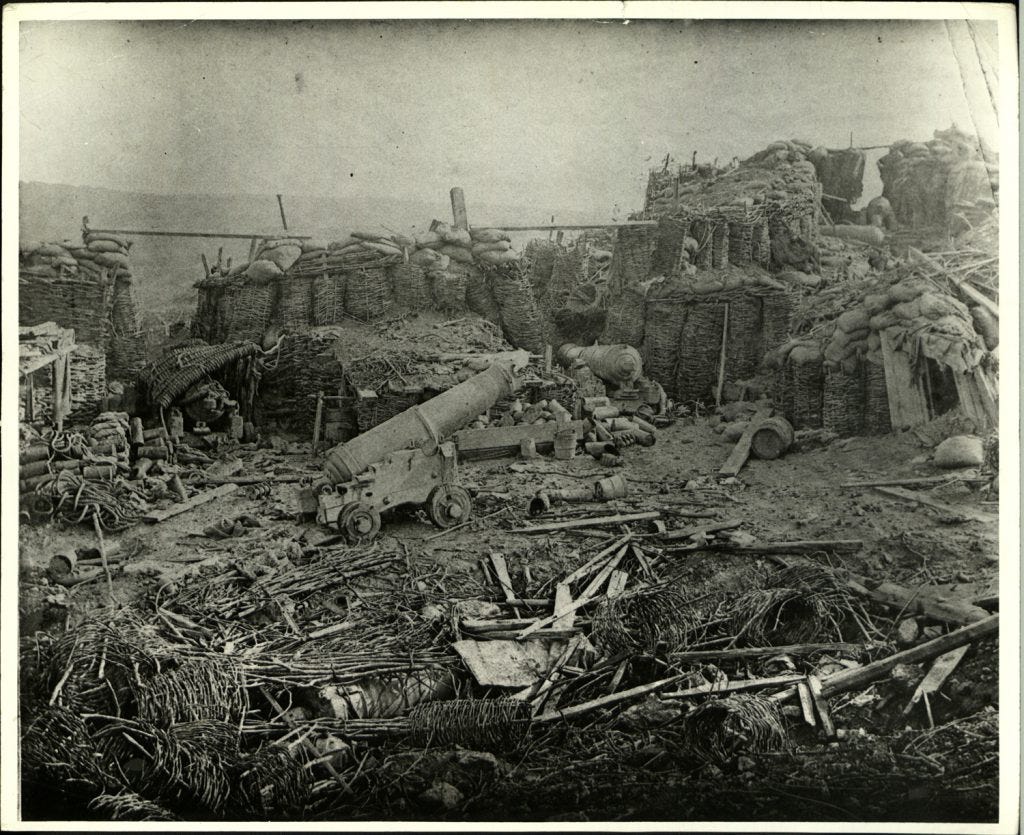
thanks to https://www.life.com/history/crimea-where-war-photography-was-born/
And the Great Game did not end at the end of the century. Harvey Broadbent, author of four books on the disastrous Gallipoli Campaign in 1915, asks why the campaign was so under-resourced and why so many basic and catastrophic errors were made. In early 1915, England was afraid that Russia was about to pull out of the war. To prevent this from happening England offered to fight the Turks at Gallipoli and give Constantinople to Russia when the allies won the war. Broadbent argues that perhaps England made a lacklustre effort to fight in Gallipoli and then supported the Bolshevik overthrow of the Tsar to allow them to renege on the Constantinople deal. It is hard to imagine but entirely consistent with the rules of the Great Game.
China is a major player in the worldview conflict today and it might be surprising that it does not appear in this historical recapitulation. The answer lies in the turbulent nature of the Qing Dynasty before its collapse in 1912 and the debilitating nature of the Opium Wars with France and England (1839-1842, 1856-1860). China calls this the Century of Humiliation which, no doubt, informs some of their actions today.
To sum up then:
1. There are two major geopolitical worldviews at war in the world today that have been at war throughout the last 500 years of history. The fights come in different disguises and are identified with different ideologies, but they are the same warring worldviews.
2. The two worldviews manifest different economic policies and are based on completely different understandings of what is means to be human.
3. There is a two-century old animosity between England and Russia that sometimes appears as subordinate to the larger worldview war but, in fact, is central to the fighting going on today.
4. Most of the conflicts in the world for the past one hundred years have been proxy wars for the underlying worldview war.
The next essay will look in more detail at possible interpretations of the battlefields on which the war of worldviews is currently being played out.
Please find a completely different (meta)Understanding of the individual and collective human situation in "2026" via the Social wisdom Teaching of the World Friend Adi Da Samraj
http://www.nottwoispeace.org/excerpt-two-is-not-peace section 3 describes the once and only significance of his calling
http://www.nottwoispeace.org/reality-humanity
http://www.priorunity.org
http://fearnomore.vision/world-2/integrity-of-the-whole
http://beezone.com/current/death_message.html Death as the Constant Message of Life
http://beezone.com/whats-new
http://beezone.com/current/thelawofpleasuredome.html The Pleasure Dome Law
http://beezone.com/lopezisland/lopezislanddescription.html LOVE IS A FIERCE FORCE