
It is hardly a unique idea and the phenomenon, no doubt, is as old as time. I call it Murray’s Secondary Dictum.
The less we know of something, the more certain we are of our conclusions.
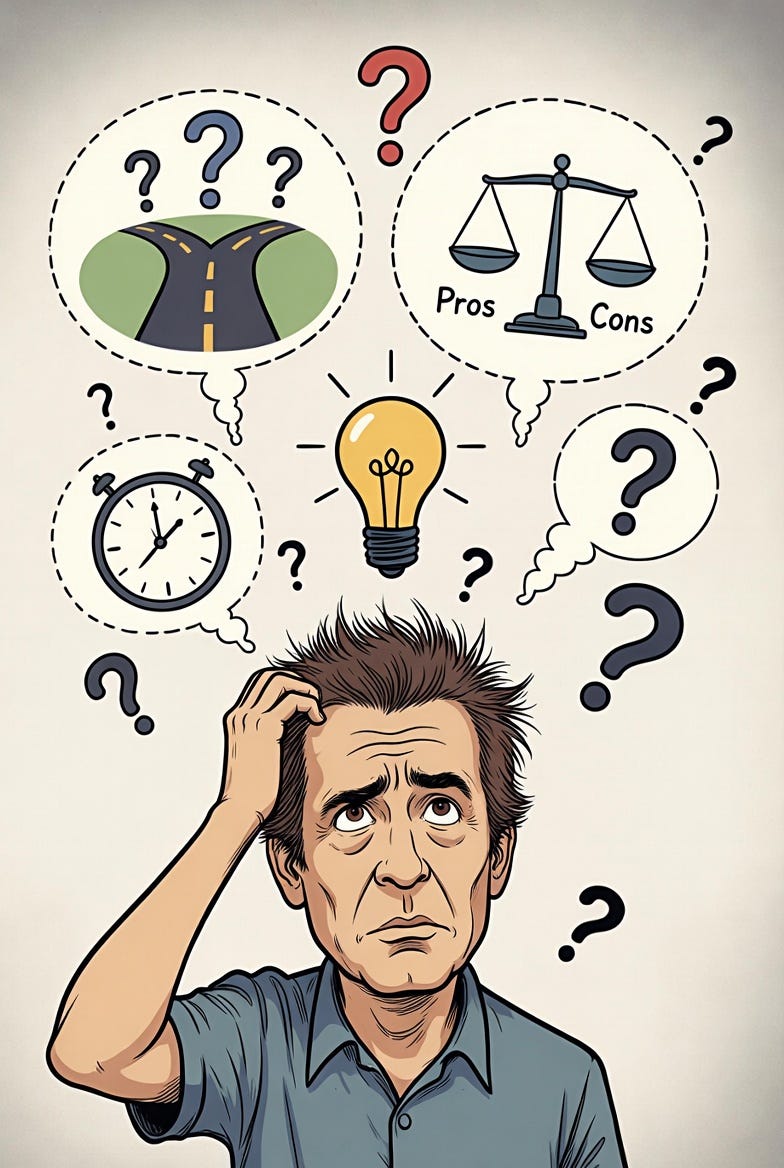
thanks to Grok
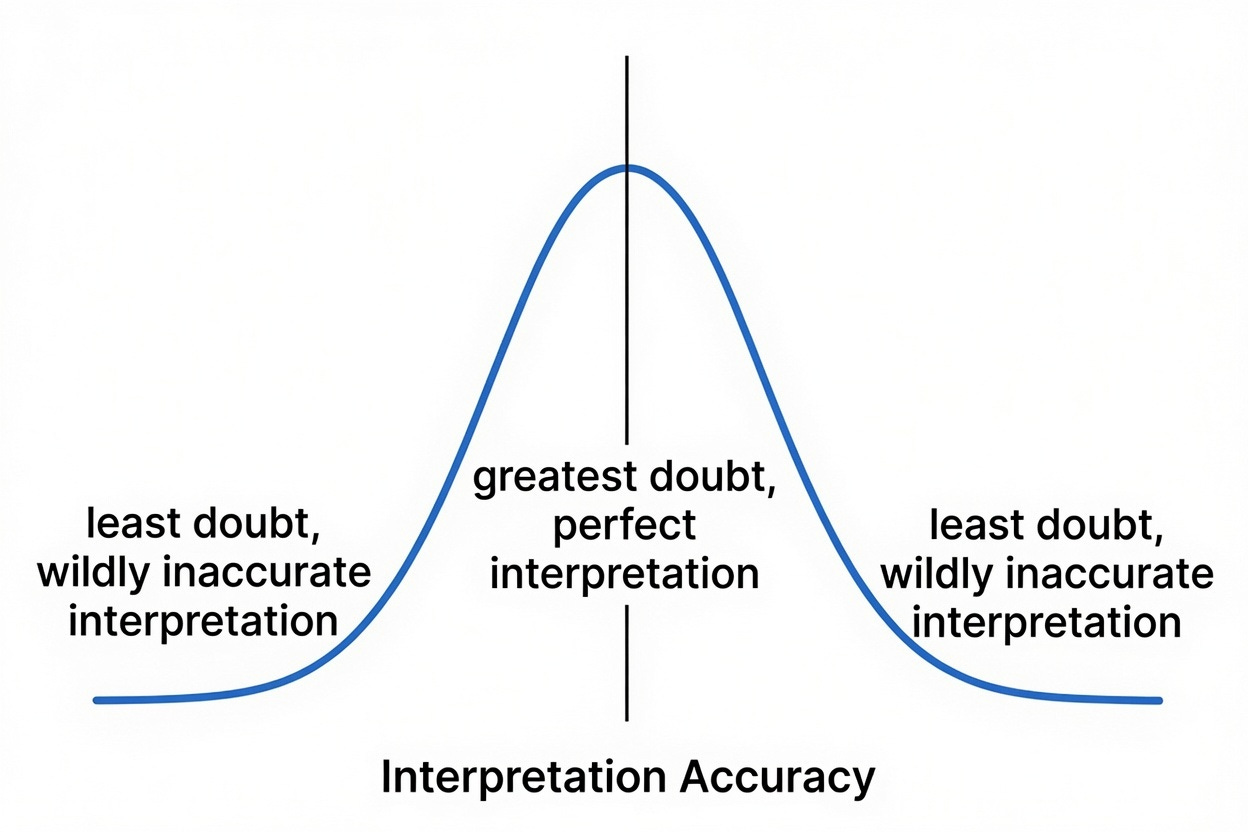
What is remarkable is that, depending upon your view of the world, the conclusions can be as wildly inaccurate in one direction as in the other. The phenomenon might be one of the rare natural, perfect normal curves. Doubt as to the validity of one’s view is greatest where the error in the conclusion is smallest and doubt is least where the error in conclusion is greatest.
For the geeks, it looks like this,
I thought about this when a friend mentioned that he was quite taken with the music and poetry of Leonard Cohen. In my engineer’s perception of the world, Leonard Cohen’s words were purposefully vague and largely meaningless. When you listen to his lyrics your first thought is “Huh?” and then you stop thinking and just listen to the melody.
Suzanne takes you down,
To her place near the river,
You can hear the boats go by,
You can spend the night beside her,
And you know that she’s half-crazy,
But that’s why you want to be there,
And she feeds you tea and oranges,
That come all the way from China,
And just when you mean to tell her,
That you have no love to give her,
Then she gets you on her wavelength,
And she lets the river answer,
That you’ve always been her lover.
“She lets the river answer that you’ve always been her lover.” Hmmm… deep. I once argued my point with a Cohen fan who saw profound meaning in those words. The fan argued that he was the cognoscenti and I was a gothic Nimrod. We each represented a tail on the normal curve above.
But Cohen completely redeemed himself with me in an interview by a true fan who wanted to hear the real meaning from the master. The interviewer even offered possible interpretations to prime the pump as it were. Cohen paused to think deeply and then said,
“I don’t know that it means that… it was just a good way to pick up chicks.”
I laughed out loud and Cohen, for all his failures has been ever after in my pantheon of sortofheroes.
JRR Tolkein made his way into my pantheon with a similar remark about Lord of the Rings. He was being queried during an interview about the semitic nature of the dwarves and would this make the orcs Nazi socialists? Tolkein harrumphed, gave the interviewer a stern look and said,
“It’s a fairy tale about little people called Hobbits, for pete’s sake. It has nothing to do with Jews.”
Again, I laughed and thought seriously about becoming Catholic in his honour. In fact, it reminded me of the takedown of Gnosticism by Irenaeus of Lyons in his book, Against Heresy written at the end of the second century AD. If you want coaching in sarcasm by one of the greats, you can do much worse than read Irenaeus. I felt sorry for the Gnostics after reading his very funny put downs.
In a more modern context, we are seeing a very similar phenomenon in the views that people have of Donald Trump. Some think that he is headed for the loony bin by year end and others that he is playing ten-dimensional chess. Representatives of both views are absolutely certain of their position and clearly neither is close to being correct. What causes such certitude in the almost total absence of real data? I suppose the problem is not the absence of data but the absence of a willingness to enter a different news silo and look at conflicting data. This is something that Scott Adams used to promote; to play a different movie from time to time to see through a different glass darkly. This is not something that I do, to be clear. When I get frustrated by the nonsense I hear from the mainstream press, I turn off the radio. No silo jumping for me.
Of course, these wide spectrums of opinion are necessary to create markets and make life under the sun actually work. What should the price of oil be tomorrow? If you believe that Iran won the first round and World War 3 is about to break out in the Strait of Hormuz then $150 per barrel seems about right. If you think the Iranians are in total disarray, have no military assets to speak of, and rogue elements are controlling their actions then $70 per barrel would be more realistic. In this way, the one who wants to sell will always find a buyer wanting to be fleeced. Or not. No one really knows the future or even the recent past, but each party is certain that they are right. Without that certainty there is no market clearing mechanism.
This phenomenon is seen starkly in a news environment in which, to expose my bias, mainstream sources have debauched themselves by taking government money and are pushing absurd agendas. This has created a news vacuum that is being filled by anyone with a decent voice, enough money for a good camera and microphone and the ability to natter at length about things they know nothing about. The internet is full of this stuff and a lot of it is very interesting. It is also mostly completely wrong - says me. I have decided that I will only listen to people who admit error when they are wrong or better yet, state that they could be completely wrong when making wild claims about this or that interesting bit of news. It really limits the range of potential podcasts.
But this too is not a winning strategy. In 2007 I had an internet friendship with a guy who was an analyst with Lehman Brothers. He repeatedly told me, with absolute certainty, to sell my house, my stocks, my vehicles and put everything into US dollars. At the same time, another friend, who understood the stock market much better than I, was expressing a lot of concern over the sale of derivatives of derivatives. “Who knows what this stuff is worth? If there is a reckoning it will break the financial system.” I had two data points expressed with certainty.
I, of course, did nothing because my little normal curve model was imbedded firmly in my brain. No stepping out to the tails for me. My analyst friend followed his own advice. I talked to him shortly after Lehman Brothers went bankrupt with the intention of commiserating over the loss of his job. He said, “Are you kidding?! I got a good payout and am moving to Texas to study theology and retire.” Did I say that he was about fifteen years younger than me?
About this time, I met a Peruvian who had also sold everything prior to the 2008 crash and bought back into the market at low enough prices to earn himself a small fortune. When I congratulated him for his insight and willingness to make a move he laughed and said it was mostly luck. “Besides my wife divorced me so I only ended up with half of it.” It made me feel much better.
Everyone is 100% certain of the accuracy of their speculation – even as they call it speculation! Few indeed offer a thought and then say, “I could be wrong.” But should they make such a qualification?
In 1066, would William the Conqueror have beaten Harold Godwinson if he concluded his pre-battle speech to his housecarls with “So thanks for crossing the channel with me and taking a strong step toward fulfilling your financial dreams. But you should also know…I could be wrong.” Or what if Martin Luther stood in front of the youthful Charles V and, instead of “Here I stand. I can do no other,” stated, “Having said all that, it is possible that I have got the whole scheme completely wrong.” He might have lost his head on the spot.
I think this conundrum is the whole point of the Monty Python “Dead parrot sketch.” When it is beyond obvious that the parrot is dead, the pet store owner breaks down in tears and avers that it is not his fault because he really wanted to be a lumberjack. That seems an appropriate response when your certainty is revealed to be built on quicksand – cry. But until then stick to your guns and argue your case with my little normal curve in your head so that you can gather the information needed to assess whether the parrot once lived and is now dead or was never alive and is a fake.
For every certainty, there are three stories to be told, and you need to know the stories at the center and tails of the curve so that you can put your faith in and money on the one which is presented with the least certitude.
But I could be wrong.