
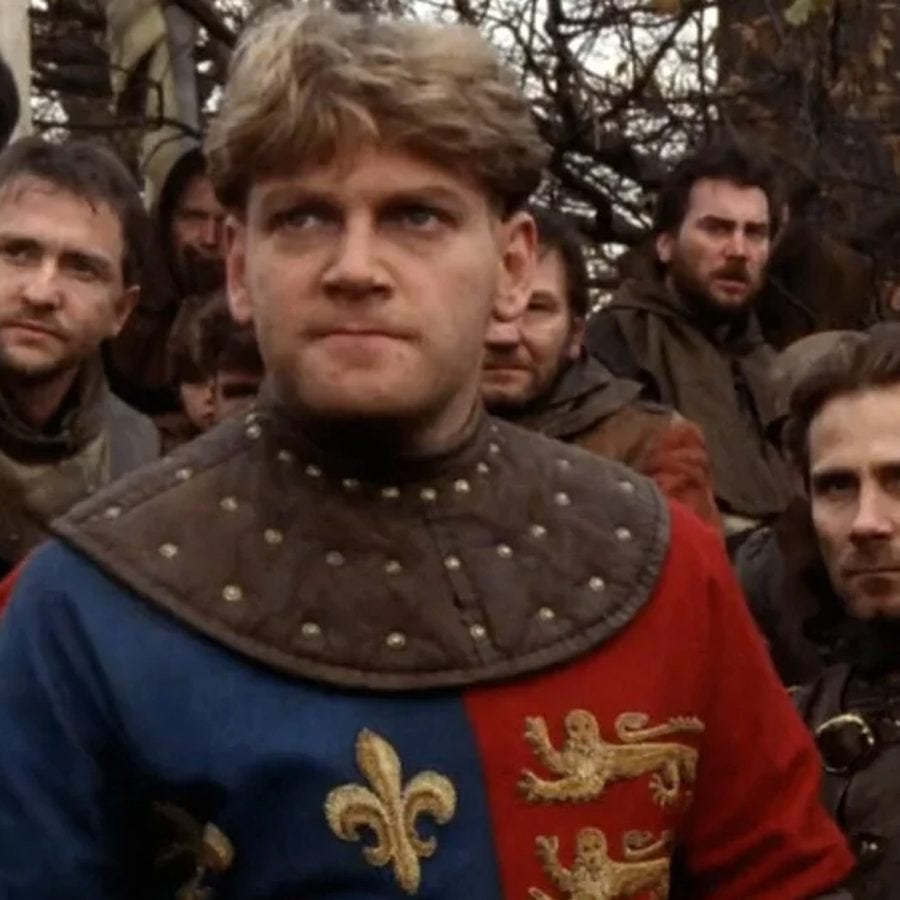
One of the reasons I am attracted to reading history is that the record is often short on details inviting the reader to make up a good story to fill in the blanks. For example, there is no historical evidence of a St. Crispin’s speech given by Henry V on the eve of the Battle of Agincourt. If he said anything it was likely along the lines of, “Ok, let’s get this over with.”
So how did the king motivate a small, sick, bedraggled and dispirited English army to defeat a refreshed and very angry French army that was three times its size? We don’t know and neither did Shakespeare but something remarkable must have happened between say 6 pm of October 24, 1415, and 10 am of October 25, 1415. Winston Churchill credits the win to the English longbow and better generalship. Maybe. Shakespeare credits it to a speech. Perhaps it was both. I like the “band of brothers” approach of Shakespeare much more than the dubious attribution of the longbow. The longbow had been introduced to Medieval warfare with devastating effect at the Battle of Crecy, again between England and France, a century earlier. Are the French really that dumb that they didn’t learn the first time around?
Similarly, I am fascinated by the actions of Cyrus the Great as described both in the Bible and in The Histories of Herodotus. He defeated the Babylonians in 539 BC and almost immediately freed all the enslaved people. “Go home! Rebuild your homes and temples and families. Live long and prosper!” Actually, it was Spock who said that last bit, but it summarizes my view of Cyrus. Freeing people, especially large numbers of people who are not related, is not something you encounter in history – other than by Cyrus. So why did he do this?
My story is that he understood intuitively that if he sent everyone home, they would choose to live in peace, make lots of money, be good citizens and increase the taxable income of his empire. It was the first discovery of the Laffer Curve and a very good modeling of Genesis 1: 26-27. Almost alone among the great leaders of history, he recognized that the economy of the world is not fixed and that people who are free from abuse will become creative in making more money and so tax receipts will increase. It is not an intuitive notion and perhaps it was for this reason that, in the book of Isaiah, written 150 years before Cyrus lived, God called him his shepherd. (And no, I don’t buy the “three Isaiahs” argument.)
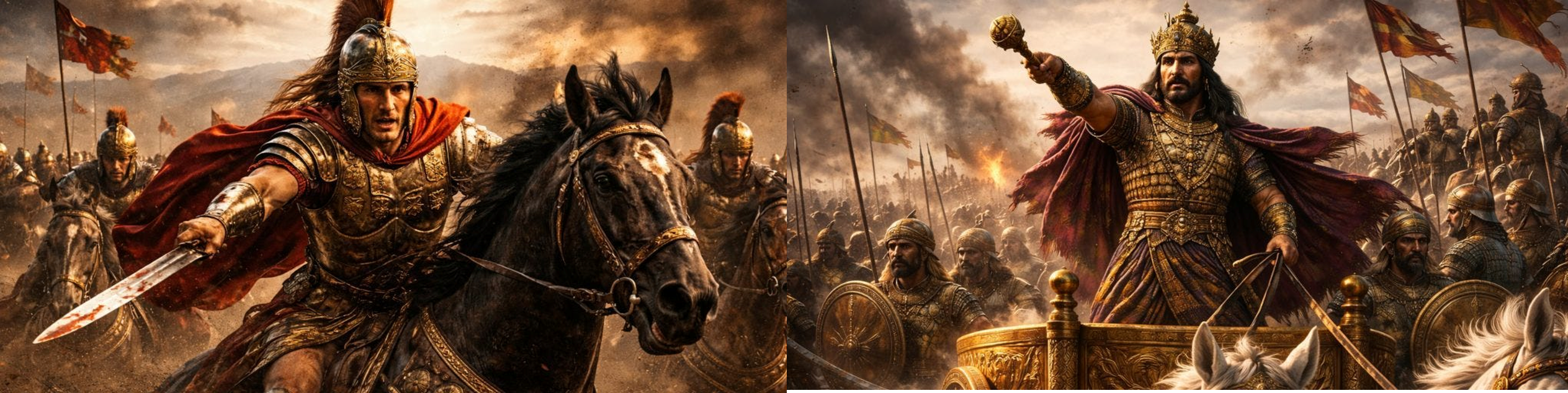
To continue the story, in 331 BC, at the age of 25, Alexander the Great defeated Darius III, a descendent of Cyrus, in the “winner-takes-all” Battle of Gaugamela. That Darius, who ruled the largest empire known to mankind at that time in history, bet it all on a single battle is very random and perhaps foolhardy and stupid. Out with the Medo-Persians and in with the Greco-Macedonians. It took another few years to discipline and replace Darius’ satraps who gave structure to the empire, but soon enough lots of new cities called Alexandria started to pop up throughout the Middle East.
Even though Alexander’s empire was soon split into four kingdoms (Seleucid in Syria and Persia, Ptolemaic in Egypt, Antigonid in Macedonia and Attalid in Pergamon), Greek became the lingua franca. The dominant culture became Greek and trade improved everywhere. Notably, diaspora Jewish traders set up shop and built their temples in the newly Greek cities.
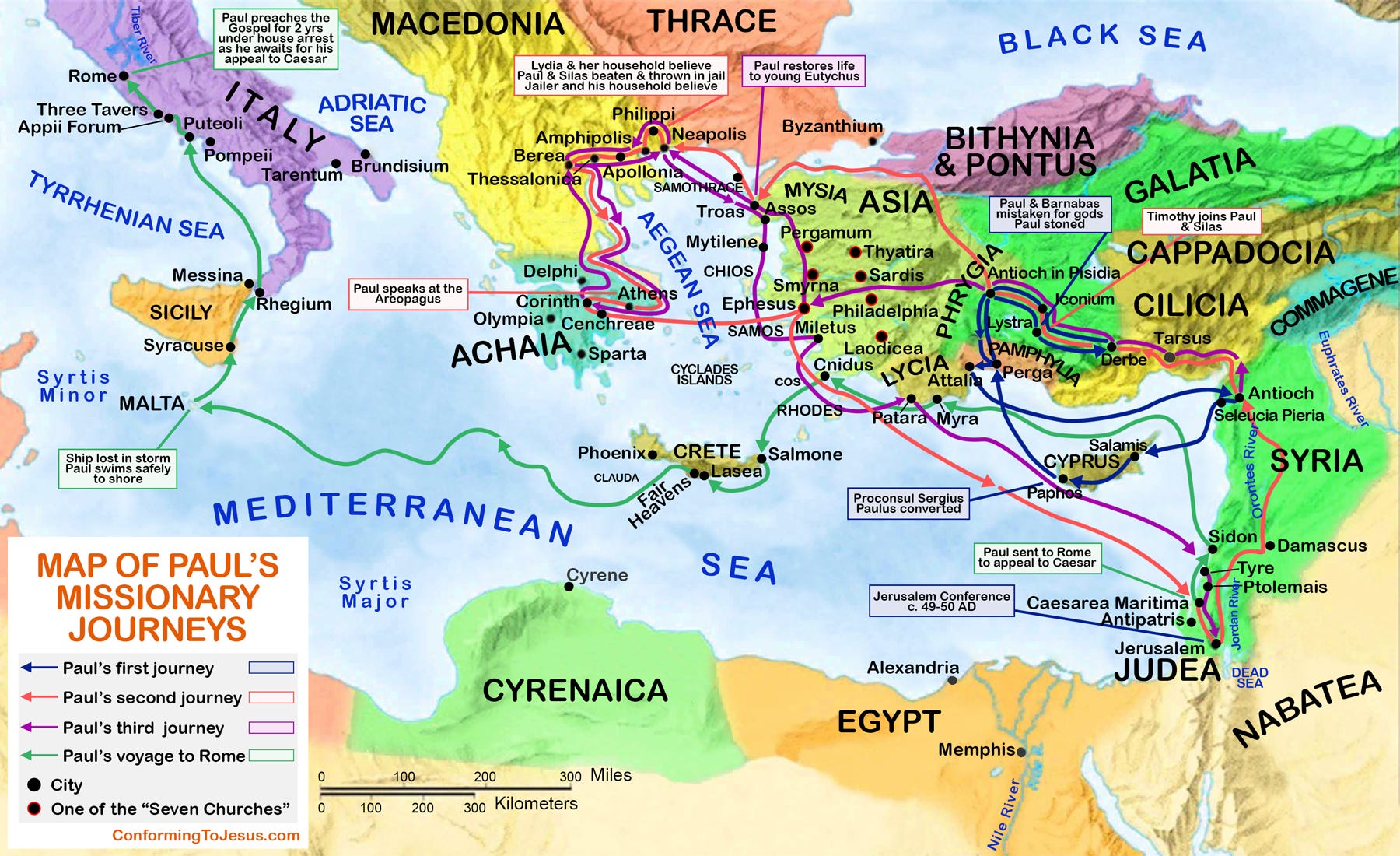
As always happens, in time another hegemon arose and defeated the Greeks. Rome took advantage of the weakness of the Achaean League and, in 146 BC, destroyed Corinth. Over the next century, despite a civil war, Rome absorbed a lot of territory from the four kingdoms. In fact, the Attalid kingdom was willed to the Roman Senate when its childless ruler, Attalus III died in133 BC.
Octavian ended the civil war by destroying the Second Roman Triumvirate. Lepidus was pushed into retirement in 36 BC and Mark Antony was suicided in 31 BC following the Battle of Actium and subsequent invasion of Egypt. In true Romeo and Juliet fashion, his girlfriend, Cleopatra, followed suit. With an end to the civil war, the Roman Senate appointed Octavian to be Augustus and Pater Patriae in 27 AD. The Republic was over and the empire began, inaugurating a 200-year period of “peace”.
Twenty-five years later (roughly) Jesus was born into a large, populous empire that was mostly at peace and, in which most citizens spoke Greek and whose major cities were populated with Jews and their synagogues. Talk about propitious timing for Jesus to enter the world and proclaim a radically new religion/worldview that, by giving honour to women and children, challenged a few thousand years of institutionalized abuse. At least that is the story I wrap around Daniel’s history, written at about 550 BC, of those 600 years.
Another vexing mystery of history is the unwillingness of Hannibal Barca, perhaps the greatest strategist ever, to finish the job that he started with such remarkable success at the Battle of Cannae on August 2, 216 BC. Hannibal had been raised by his father to hate the Romans and at age nine he swore a sacred oath to avenge the losses of Carthage in the first Punic War.
In the Battle of Cannae, according to the historians Livy and Polybius, Hannibal took advantage of the arrogance of Gaius Terentius Varro (who ignored the much sager advice of Quintus Fabius Maximus) and completely destroyed eight legions of the Roman army. Plutarch wrote that Hannibal, in response to his general Gisgo’s comment about the astonishing size of the Roman army, stated that “Consider also that in all those great ranks before us, there is not one man called Gisgo”, suggesting that Hannibal also had a sense of humour.
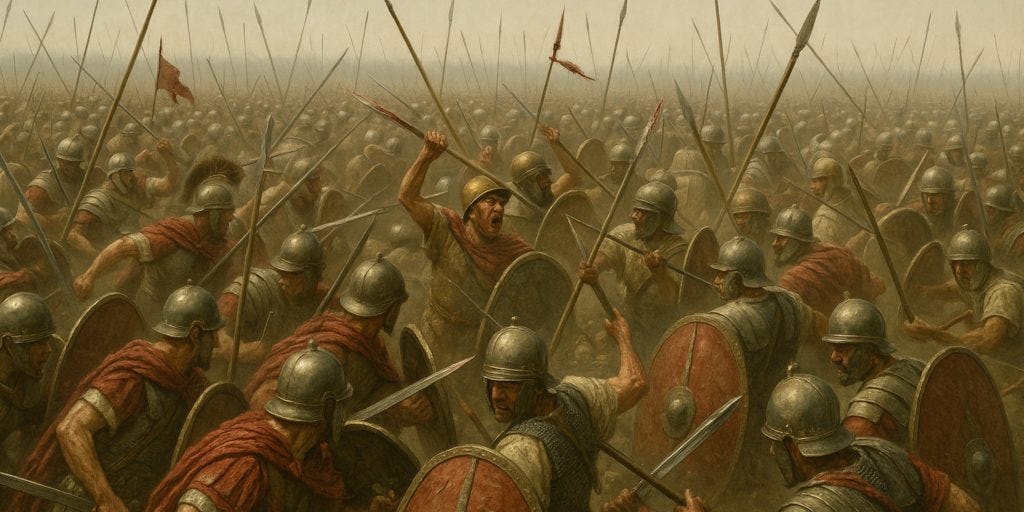
Estimates of the number of slaughtered Romans vary from 45,000 to 70,000. Both Livy and Polybius state that the Romans were so closely pressed by Hannibal’s troops that most couldn’t lift their arms enough to strike with their swords and died on the spot. The small remnant of the army was ostracized to Sicily until, tired of their pleas for an opportunity to redeem themselves, Publius Cornelius Scipio Africanus took them with him to destroy Carthage at the Battle of Zama in 202 BC.
Following the Battle of Cannae, the Imperial city of Rome was left unguarded and wide open, yet Hannibal sat on his hands. His own generals pleaded with him to march on the city and destroy it. He wouldn’t budge. According to Livy, Hannibal’s general Maharbal stated, “You know how to win a victory, but you do not know how to use it.” Polybius argues that Hannibal felt he didn’t have the equipment to conquer the city. Perhaps there is another reason for not finishing the job.
In the Old Testament, we read that the Hebrews who left Egypt to occupy the Promised Land of Canaan were told to rid the land of its inhabitants – no one was to be left alive. Why was God so cruel? Perhaps it was because the Canaanites and Philistines sacrificed to their gods by ritually throwing their children into a fire. Nice. What did Jesus say?
“It would be better for them to be thrown into the sea with a millstone tied around their neck than to cause one of these little ones to stumble.”
So much for gentle Jesus, meek and mild. I don’t think it is a stretch to interpret “thrown into the fire” as “cause one of these little ones to stumble”.
Hannibal was from Carthage, a colony of the Phoenicians, a people who also practiced child sacrifice. Is it possible that Hannibal’s ambitions were stayed by God to prevent child sacrifice from being adopted into a now former Roman culture and then finding its way around the Mediterranean basin? Who knows but, to me, this seems a more likely explanation than the want of a few catapults.
The existence of child abuse and the punishment for it is a well-aired theme in history. Nor is it a practice unknown to more modern times. In fact, there is credible evidence from government hearings that 350,000 children were brought illegally and without their parents into the United States between 2020 and 2024 and were then “lost”. I think we can guess what “lost” means. But then the questions begin. Were they “lost” or did their relatives reclaim them and just not let anyone know? Were there really 350,000 or were there a handful expanded to hundreds of thousands for political reasons? Do we really believe that poor parents from the Developing World would put their children at such risk just for the remote possibility that the family would later be reunified in the US? Would the US government really involve itself in such widespread human trafficking?
Here is a curious observation. When we suggest stories to explain modern events they always sound like conspiracy theories. It seems that the closer we are to an event, the more invested we are in a particular interpretation of that event and anyone who disagrees with our interpretation is just weaving conspiracy theories. When we weave stories to explain events from deeper in the past, they are rarely treated as conspiracies but just as interesting stories.
It is surprising how much of history is interesting stories.