
As our American cousins celebrate the 250th year of their existence as an experiment in human freedom and self-government and as their Canadian cousins in Alberta consider a less universally seismic yet no less important break from Canada, the word “revolution” comes easily to one’s lips.
In episode six of his multipart exploration of the American Revolutionary War of Independence, Eric Metaxas and Os Guinness explore the question, “What beliefs must a people hold in order to remain both free and human?”
Coincidentally, the Alliance for Responsible Citizenship (ARC) is holding its annual conference in England addressing the theme, The Age of Reconstruction. On day two of the conference, among other talks, were three speakers exploring the phenomenon of large language models and artificial intelligence. The erudite and qualified speakers included Chloe Lubinski of Anthropic, Ross Douthat of the New York Times and Jonathan Pageau. They addressed similar questions as Metaxas and Guinness.
It is good that smart people are addressing themselves to these issues but if they really want an answer to this question, they should have addressed the query, as per the very funny poet Pam Ayres, to the right person. In this case… to me.
All of the above videos are, in my view, worth watching and each expert probes the issue of humanity, agency and freedom from different perspectives. Ms. Lubinski thinks that AI is powerful and getting more powerful with increasing speed (Anthropic and AI) . It must be understood technically and in the context of humanity for its power to be well harnessed without blowing us and it up. Mr. Douthat recollects the radical changes in human existence that have taken place in the past twenty years, particularly for those who came of age during this time (video suddenly not available). In his view (by my interpretation) we are living an ersatz existence that is navigable by most but leaves increasing numbers of people emotionally and socially shipwrecked by the rapid changes in human interaction.
Jonathan Pageau takes that theme further and questions whether, in twenty years, there will be any remnants of humanity as it was once understood due to the wreckage of uncontrolled machine intrusions into human activities and relationships (Old stories). He concludes with the advice that the best antidote for the anti-human trend in society is to read the Bible, go to church and pray. Which is pretty good advice it seems to me. But this has been pretty good advice every day for the past two thousand years and above average advice for all the days which preceded those two thousand years.
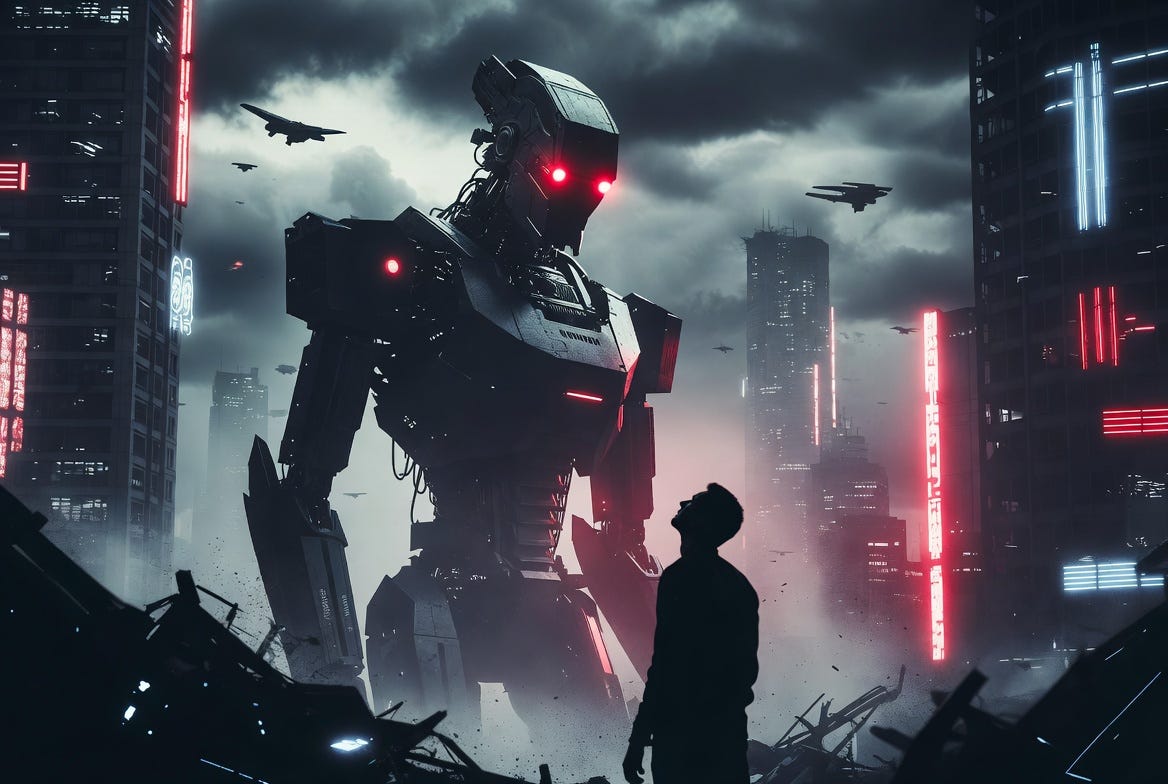
I am not going to relitigate the issues of large language model artificial intelligence as I have addressed that issue previously and really don’t have much knowledge to impart. I tend to pay attention to my friend Keith Lowery who more than dabbles in this technology and has an informed and balanced view of it. Besides, I recently listened to Paul Kingsnorth give an interesting conference address about the terrors of “the Machine” and found myself disagreeing with much of his dystopianism.

What I don’t think is being properly addressed generally, and in the videos referenced above in particular, is the historic nature of the struggle between man and machine. On all sides we are assailed with breathless admonitions that the world is changing drastically at ever increasing rates. I respond to this with the words of Cicero,
“To be ignorant of what occurred before you were born is to remain always a child.”
The world has changed far more dramatically and far faster on several previous occasions, and our historical chauvinism cannot change that. We really need to teach more history.
In the period 1348 – 1351, up to half of Europe was killed by a bacteria called Yersinia Pestis – the Black Death. And those deaths did not take place over the four-year period. They took place over a two-week period repeated in town after town throughout Europe. First, you would be informed that something weird was happening in a town one hundred kilometers away. Then you would find out that people were dying quickly and horribly and now the death was only 75 kilometers away. And each week you would hear about the latest horror and would learn that the death was coming ever closer. Then it struck your town and every day for two weeks bodies would show up on the street. Sometimes whole families lay dead in their homes. The local priest was dead; the children of the local lord had all died and one of your children was recently acting listless and sore. The horror was as much in the anticipation as it was in the event itself. Read “The Plague” by Camus for a good description of how a population learns to cope with such change.
Did the Black Death change the social and family structure of European society? Did the world turn upside down physically, socially, economically and spiritually in a few months? Yes, it did and it was a change far more profound than the recent availability of computers.
Up until 1445, Europe suffered rampant illiteracy with few books available to be read. And those that were available were so expensive that only royalty could own them. And whoever owned them had to know Latin to read them. By the end of the century, thousands of books in vernacular languages were being written, printed and sold. Literacy was improving and new ideas were being spawned and distributed across the western world. And if that was not enough, a whole new world populated by heretofore unknown people had been discovered. Was the world changed by the printing press and the age of discovery?
Everything was changed and the pace of change was everywhere accelerating. By 1517 the unitary worldview of the western world was exploded in the musings of a backwater German priest called Martin Luther who became the social media guru of his day. Someone has estimated that Luther authored ten percent of all things printed up to his time and, arguably, it was his understanding of the power of the printing press that saved his life.
The Great Divergence that led to the explosive development of the western world, identified by many historians as having mysteriously taken place in the early sixteenth century, is surely not a mystery. The inflection point of this divergence was Luther’s new worldview driven by his prodigious outpouring of printed material.
In the early 18th century the English Parliament took on a larger role in the management of England. This followed a century of political turmoil in which one king, Charles I, was beheaded followed forty years later with a glorious revolution to replace his Charles’ Catholic son, James II, with his Protestant granddaughter, Mary of Orange. The relative peace and freedom of this Parliamentary control led to a technological revolution that shook Europe in waves for the next two hundred years.
In 1712 Thomas Newcomen, working off plans described by Vitruvius at the time of Caesar Augustus, developed the first commercially successful steam engine to pump water out of the deepening Cornish tin mines. Fifty years later James Watt included a separate condensing chamber to increase the power of the engine. It ushered in a new age of industrial and transportation development - and social chaos. As the new industrial processes were built into “dark, Satanic mills”, life in England, then France and then Germany was turned upside down in ways far more important than the advent of the iPhone. Massive urbanization, increasing poverty and dehumanizing work led to huge social disruption. The wistful longings of the Romantic poets of England (Wordsworth, Shelley, Keats, Byron, and Coleridge), arguably the apex of English literature, was a direct result of the industrial revolution. For all of its social dislocations, which were ultimately temporary if somewhat long lasting, the industrial revolution also demolished the remnants of feudalism, introduced the emergence of a middle class and, economically, floated all boats resulting in a whole new set of social problems and issues.
Enough, then, with the arrogance that somehow our age is unique in the degree and speed of change. There is nothing new under the sun and mankind has always been able to derive a new epistemology from changes in technology and their attendant sociological curve balls. And the resulting epistemological changes incorporated the good effects of the new technology and mitigated the evil effects. In 1525, the Europeans attempted to address the massive worldview changes introduced by Martin Luther but it took until 1555 for the right formula to be developed. Arguably it took another half century to work it all out politically and economically. In the light of the Peace of Augsburg then, should we be so worried about addressing the issues which attend the iPhone and its access to chat lines that elicit far too much personal information or large language models which seduce luckless males into believing that HAL loves them?
I think it is time we get a grip on our fantasies, ignore the doomsayers and end our historical chauvinism. Yes there are serious issues with the new digital technologies. There have always been issues and once we solve the current besetting issues there will be new issues which beset us. Life will go on, boys will once again figure out how to talk to girls and babies will be born. How do I know this? Well… history for one. But also, I find it encouraging that we are asking the right question.
How do we remain free and human?
For most of history, the answer to the question was restricted to issues associated with humanity. I am not a dog or cat or sheep or bear so I must be a human. Therefore I work. Thanks to Luther’s reminder of the teachings of Christ, we now link being human to being made in God’s image and that comes with certain upsides. Among those upsides is the notion of personal freedom in a complex society and the right to protection from the abuse of my neighbour and my government. And freedom from abuse leads to expressions of creativity. Will artificial intelligence rob us of freedom and creativity? It seems to me that AI is a direct result of freedom and creativity rather than attempt to steal it from us.
Undoubtedly the current geopolitical fight between globalism and nationalism is resulting in attempts to curtail personal freedom but correlation is not causation. I can find no direct link between the rise of artificial intelligence and loss of freedom - fears of digital currencies and ubiquitous facial recognition cameras notwithstanding.
A review of the history of man’s attempts to control the freedom of other men would fill a library of books. Today’s attempts to control freedom are born of the dark heart of mankind and are not an inherent attribute of artificial intelligence. Might AI be nefariously used to control individual freedom? Of course. Just like ropes are used to tie up boats and the people you want to rob. Is the rope the problem?
My argument is that, as long as we are asking questions about the upsides of being human – freedom and creativity – we will be fine. History has demonstrated this repeatedly. Cyrus the Great figured all this out 2500 years ago when he freed the people enslaved by the Babylonians. Jesus reminded us of the need to end the abuse, and Martin Luther gave action to the reminder. He, no doubt, had in mind the words of Paul who wrote that there is no law to stand against what he called the fruits of the Spirit (of God) - love, joy, peace, patience, kindness, goodness, faithfulness, gentleness, and self-control. These are further upsides to being human when we take the time to remind ourselves of who we are.
Fortunately, when we ask questions about the linkage between being human and being free we find creative solutions to the new social issues that attend developing technologies. We always have. And in time, things will be fixed. I am optimistic.
Thanks for the optimism. AI will never understand the human spirit.
This reference provides a thorough-going critique of a dreadfully sane talking head you mentioned at the beginning of your essay:
http://americanloons.blogspot.com/2018/04/1995-eric-metaxas.html
Since then his antics have become even more extreme.
He was an enthusiastic participant in the pretentious March on Jericho protesting against the Obama administration. At about the same time I listened to a long interview with a former deputy Prime Minister of Australia wherein he (pretentiously) claimed that all unchurched non-believers had NECESSARILY to be converted to the one-true-way, as defined by him. I found that statement to be quite chilling. Anyone for christian fascism!