
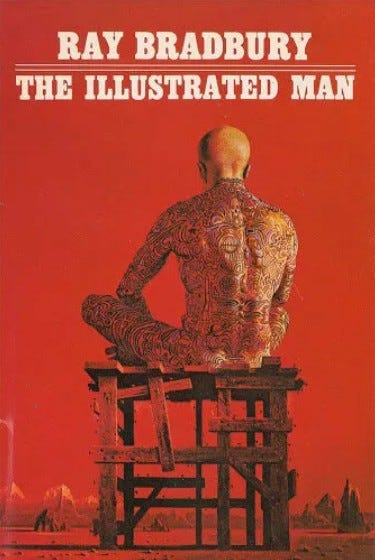
In Ray Bradbury’s excellent book, “The Illustrated Man”, a heavily tattooed carnival “freak” uses his ability to animate the tattoos to demonstrate the threats to human psychology at the edge of technological dehumanization. This essay is written with apologies to Mr. Bradbury’s imagination.
Class of /71, I salute you!
Over the left side of his chest an older man stood up grimacing from the tightness in his hips. The underlying spots of keratosis increased in size as the figure straightened to full height, stumbling a little.
The concept of the class reunion is widespread and popular across the United States but much less so in Canada. Latin Americans scarcely know what a high school reunion is – at least according to a quick search of Reddit. In my small Canadian hometown, the high school reunion is almost an institution. Every five years there is a reunion that most classes observe. The reunions are integrated with an annual community celebration known as Julyfest and are generally organized by those classmates who continue to live in the community. This past summer I attended the 55th reunion of my class of 1971 having previously attended the 20th and 45th reunions. This latest did not disappoint.
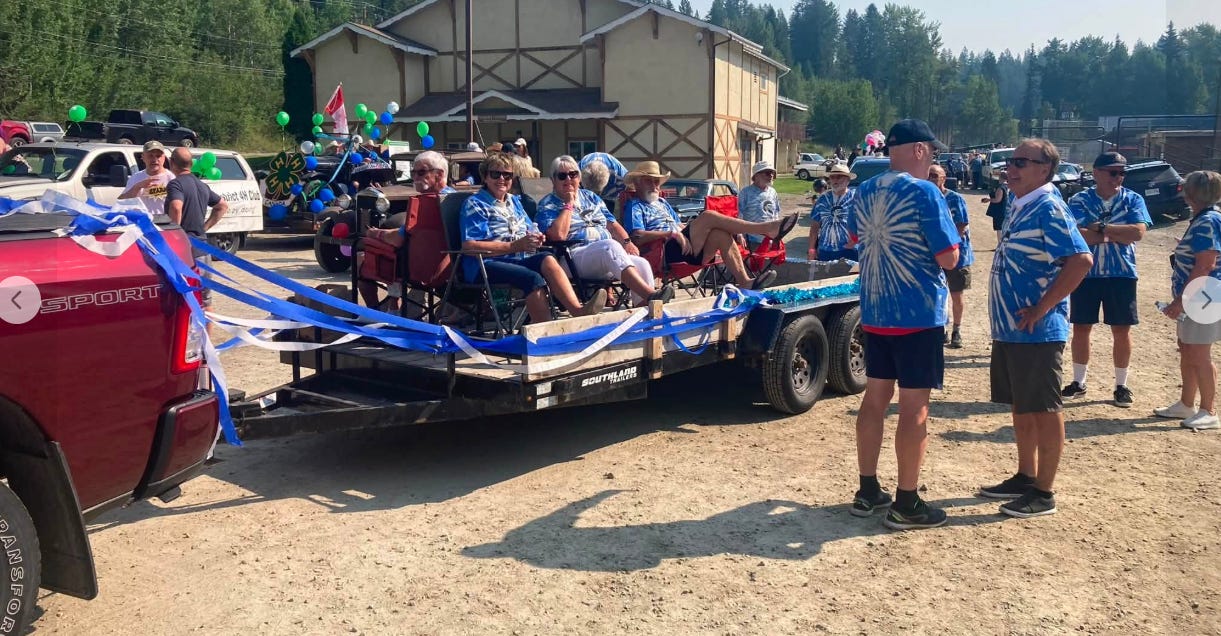
Our class, like other reunion classes, obtained a flatbed trailer for those who chose not to walk the 3- or 4-kilometer parade route. With minimal decoration, coordinated t-shirts, and as much spunk as could be mustered, we joined the parade and were subject to the indignity of little kids along the parade route spraying us with monster water guns – even as we threw candies out to them. It felt like the geriatrics were being put on the ice flow and was both very funny and a lot of fun. Most of the remainder of the reunion was spent sitting out of the hot sun under a canopy in the bocce pits reminiscing with classmates.
Fifty-five years removed from graduation means that there is no competition or sense of “where do I fit in the pecking order of financial and work success among my classmates”. At our age, being alive is sufficient reward for attendance. In fact, someone mentioned that over 30% of the class had passed on. It was a sobering realization.
What I most appreciated and enjoyed about the conversations I had with the thirty or so classmates that showed up for the reunion was hearing the stories of those who had left the community and then came back for varying lengths of time. They were the stories of young men and women who moved out of the parental home to rent small apartments nearby and who viewed the community through the eyes of young adults sorting out their futures rather than as callow youths who just wanted to get out of town. I was firmly in the latter camp and hearing the often-hilarious stories of adventure and misadventure of those who returned opened a window into the community that I had not known existed.
One of the more interesting reflections in our conversations was the humanity of the mining company that sustained the community for over one hundred years. When I left my hometown within a week of high school graduation, I like William Wilberforce, felt that God had placed before me two great objects for my life: I would never enter the mining industry, and I would never return to live in my hometown. Five years later I returned to my hometown as a young engineer at Cominco’s Sullivan mine. Apparently, I mistook my great objects for those of God. And, apart from that mistake, I learned that God has a sense of humour.
The previous summer I had worked for Cominco in Yellowknife and, following the battery of standardized tests that the company gave to all its technical summer students stated, in Shermanesque fashion, that if given an offer of permanent employment I would refuse to accept. Unlike my fellow graduates who got multiple offers of employment, my only employment offer came from Cominco to work in my hometown. What option did I have? Furthermore, when we moved to Kimberley, there were no rental accommodations and my wife and I lived for three months with my parents who had been underwhelming in sanctioning and blessing our marriage. After the three months my parents wanted to trade me in and adopt my wife. This transformation only makes sense to me as a God-thing.
Cominco was stolid and conservative, and the mining office was full of men whose contribution to earnings had known better days. Yet they never feared layoff or other employment disruption. Over time I have come to see this generosity, contra the numerous times I was subsequently threatened with layoff, as a function of the social changes described by Charles Murray in his book Coming Apart: The State of White America, 1960–2010. Murray describes the slow erosion and bifurcation of socially mixed communities into rustbelt communities - “Fishtown” and effete, upper class communities - “Belmont”. In the 1960s the company bosses lived in the same town as the company workers and the lives of their families overlapped in many ways. Executives didn’t treat lay offs lightly when those laid off shopped in the same grocery store and had children who played with theirs.
The world has changed and maybe layoffs are sometimes required but I have always thought that Cominco was a remarkable company which may have been an anachronism but, if so, was a very human one.
My conclusion to this weekend of deep reminiscing is that there is something categorically different about the relationships that are formed in the crucible of hormonal changes and, perhaps because of the turmoil of the teen years, the nature of the relationships is rather more sinewy than those of other relationships formed as adults. Without making too much of the reconnection, several times during the reunion I was struck with the notion that I was in the presence of remarkable people who I liked being around. For an introvert that is saying a lot.
The Promethean bargain:
When his back was touched, the skin warmed and smoke began to rise. The outlines of the small home became distorted and then collapsed into a heap. Watching the destruction was not as terrifying as was formerly assumed and the loss of the home, while tragic, was not mourned as deeply as anticipated.
For years I have told my grandchildren that, in fact, I am a Master of the Universe with secret powers. This is demonstrated by the fact that when Josef Stalin died in 1953, I was born and the exchange has been considered a profitable one. As with Santa and the Easter bunny, the pretense ends with the increasing age and decreasing credulity of the beguiled.
Something else happened in 1953 and that was my father and uncle’s construction of a small lakeshore cabin that has been instrumental in establishing the contours of my soul. As I have grown, so too has the cabin and, with age, it becomes a more important metaphor of my life. “This is the tree my brother fell out of and whose fall was broken by my nose. Over there is where we burned the rowboat when the hole in the hull grew too large. In the corner of the bay is where I cursed my last over the motor that wouldn’t start and which sank to its death after it pulled the transom off the boat.” That sort of thing.
And I have reveled in watching the souls of my children and now grandchildren also be formed by the magical amalgam of water, bush and freedom. But the arrangement is very Promethean in the sense that carving living quarters out of a forest has its risks. For offering humanity the gift of fire, Prometheus was chained to a rock. The natural world will not be cheated, and the summer cabin is always at risk of being consumed by the gift of Prometheus.
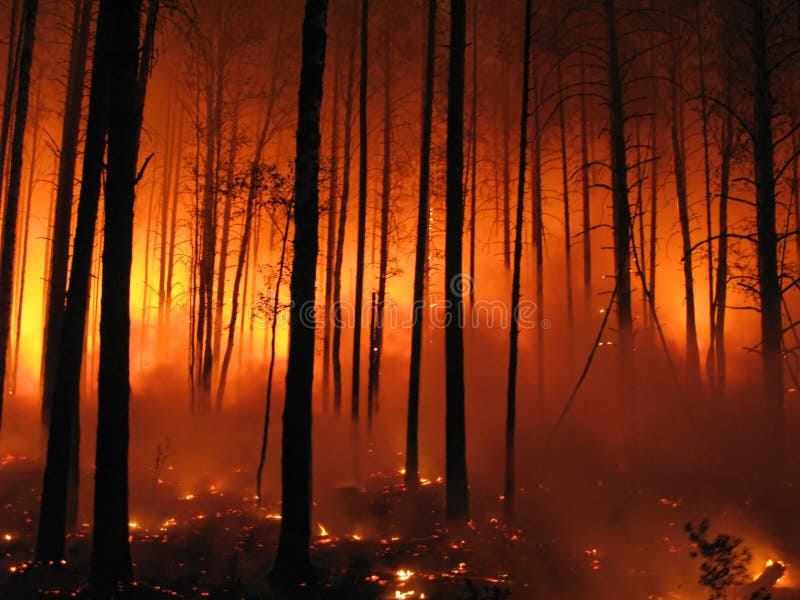
We found that out in spades a couple of weeks ago when our small, soul-forming castle was threatened with fire. We watched with wonder and increasing concern as a small fire first spotted approximately 15 km to the west at 4:30 pm became a wall of flame by 6:30 pm. All evening, we were entertained by six fire retardant bombers and an unknown number of water skimmers. The bombers were surprisingly large and loud and their ballet as they circled overhead pouring their cargo on one of four fires in the area was mesmerizing. My mind went to the Berlin airlift or the Battle of Britain. The wind velocity increased and the wall of flame rose and seemed to be coming closer.
By 9:30 pm, the Wildfire Service announced an evacuation alert. Within an hour the alert was changed to an order, and the exodus began. Go-bags were thrown into cars and the line up at the local gas station lengthened. An hour later, the entire valley was shrouded in darkness as the fire destroyed part of the power line.
As we brought out the generator and packed the cars, a close eye was kept on the pace and direction of the fire. A few decided to stay behind until the last minute to ensure the water sprinkling system was still active and the rest of us left, some going north and others going south. Fortunately, and serendipitously, we all had full gas tanks. Otherwise, the power outage had removed a basic requirement for modern living – availability of gasoline. Motel and hotel accommodations in the area quickly filled up and some of us slept in cars. My responsibility was to take my daughter and son-in-law and their young family to a nearby airport to catch a flight home. At 5 am, bleary-eyed, we finally found a small motel with room for us all.
(credit to Dreamstime.com)
Within twenty-four hours of the evacuation order, the air temperature had dropped and the wind stopped. The spread of the fire was arrested by the firefighters although it continued to burn within the established boundaries. Within two days, the evacuation order was downgraded to an alert, the power was back on and we returned to the property to sort out the mess left behind.
Did the Wildfire agency jump the gun and force a lot of people into a precipitous and very uncomfortable flight from the vicinity of the fire? In retrospect, I suppose the answer is yes but to my surprise I was not bitter about their decision and was profoundly appreciative of their efforts.
When I considered the aerial ballet of the opening attack it occurred to me that the pilots were maneuvering in a very crowded corridor while fighting high winds and rising columns of heated air. Beautiful as it was, it was also very dangerous. Who volunteers for that level of danger? People who are so well trained that the danger is largely mitigated. It is humbling to know that such people exist and are willing to fight fires on my behalf. It puts the discomfort of my sleepless night in a necessary perspective.
It was a close call that has generated lots to think about. How far am I willing to go to protect a little piece of paradise? Has the modern world triumphed over Zeus and is Prometheus now unbound? It would seem not. How should I respond to that realization? Does fire only destroy memories or does it also create memories? Should we double down on Prometheus and go for more protective technology, or will this just lull us into a deeper ambrosian dream? Socrates tells us that only the examined life is worthwhile and the Bible teaches that the good life is balanced in all respects other than the fear and love of God. How does all this fit into the management of soul-forming?
The end of all things:
The figure was laying in bed and when it was touched, nothing happened. Close examination showed that his arms were folded over his chest, his eyes were closed and a faint smile was on his lips. But he didn’t move.
When my children were older teenagers, a Christmas present from their father was an essay on the importance of a daily reflection on their own death. I think it was a big hit with them although they all asked for socks the next year. At my age when the essay was written it was easy to think about death in the abstract, but few days have gone by that I haven’t thought about death. My argument to support such morbidity comes from Livy and Solomon. Life can only be fully understood, appreciated and enjoyed, to the extent that death is accepted, understood and anticipated.
What I have discovered in the twenty years since the “Gift” is that the nature of the reflection has changed. With each new lump and carbuncle, with each new twinge and stab of pain the ultimate reality of life becomes more besetting. If the ultimate reality of life is death, then, beyond accepting and anticipating, I should know something about death. My ruminations on this topic are decidedly Christian because Christianity is based on a savior/leader who died and came back to tell us about it. And, by the witness of several hundred people, He didn’t die again. He just left, as He said, to prepare us a home. I find that believable because it is historic. And it is very comforting.
But what is death? In 1991 Pam Reynolds was “killed” and cooled preparatory to excising a tumor from her brain. She literally was drained of blood, her heart was stopped, her brain activity was ended, her tumor was cut out, her blood was warmed and returned to her body, her heart was started and her brain activity recommenced. And this activity continued until her death in 2010.
Her 1991 operation was witnessed by a room full of doctors and clinicians. As remarkable as this operation was, Ms. Reynolds also related some of the operating room conversation and activities that took place when she was clinically dead. So was she dead? Can death be faked? Or is consciousness different from brain or heart activity? I certainly don’t have answers, and I don’t think anyone else does either. This death business is complicated.

(thanks to Grok)
What is troubling is that a significant minority of people think there are altogether too many of us walking this terrestrial ball and they never include themselves in the list of those who need to step off. Our federal government has demonstrated its benevolence by giving a name and a policy to this “stepping off”. It is called MAID; as evil a euphemism as has ever been constructed. George Orwell would be impressed. But it gets worse.
We are being encouraged to step off by billionaires like Bill Gates, Peter Nygard, and Bryan Johnson (and others) who have made public their intention to live forever. Nygard pursued his dream to the extent of allegedly impregnating young girls so that he could harvest embryonic stem cells for his longevity experiments. Alas, the Bahamian government took a dim view of his ethics, and he is now in jail for sex trafficking.
Would the world be a better place with an eternal Bill Gates? I know it wouldn’t be better with an eternal me as I would be a cranky Tithonius, evolving into a chirping cicada. I expect the same would be said of Mr. Gates. There is a reason that most ethical systems warn against living beyond a standard deviation of the ages of your peers – such a life ceases to be soul building. So why do so many of the rich and powerful seek that which they know will be empty? Is it because they need to escape the consequences of what they did to gather their wealth? I don’t know but it seems to me that the fear of death results in an increasingly crabbed and lonely life.
So what is the Illustrated Man saying?
1. Adolescent relationships make lasting memories that are renewed and shareable within nanoseconds of meeting again. The patina of time is dissolved as soon as a name is put to a face, and the value of the memories becomes more bronzed with the intervening years.
2. Soul forming memories are made in geographic locations occupied by the people vital to one’s existence. Neither structures nor toys contour the developing soul. If the gift of Prometheus had burned the cabin to its foundation, the quality of the souls formed within it might only be improved.
3. Relationships and forever-forming souls are meaningless except in the context of inevitable death. Like those pine trees whose seeds will only germinate after the heat of a fire, human souls can only be fully exposed when the body’s husk is pulled away. Death is not to be feared nor is it to be invited. Perhaps our world appears so topsy turvy because we have such a stunted view of it.
Is the Illustrated Man correct? Are there connections between these summer experiences? Is death a gaunt, Grim Reaper in a hoodie carrying a scythe? Or is he a kindly, strong man helping us over the stones crossing the River Styx?

(thanks to Grok)
The death of Thomas “Stonewall” Jackson provides an interesting data point about the nature of death. Having been shot by friendly fire, he lost his arm and then died from septic fever. Just prior to his death, he sat up in bed, pointed his finger and said, “Let us cross over the river and rest under the shade of the trees.” What river General Jackson? And please explain the trees. His vision has been my metaphor for death ever since. It reflects the imagery of the garden and beautiful river described by the Apostle John in the final chapters of his Revelation.
My point in all this is that I believe that life under the sun is lived to form souls that can function in an alternate level of consciousness, often called Heaven. And those souls are always formed by relationships with other people who share our experiences. They are never formed by material wealth or high paying jobs. It is not true that he who dies with the most toys, wins. Rather, he who dies with the richest relationships and shared experiences wins. If you accept my metaphor of death - the calm river and the shading trees - you will be led to Jesus, the One who conquered death and is preparing the Heavenly home for those who accept him at his word. A relationship with him is the richest of all, says me.
If you don’t accept my metaphor, then you will have to sort out death in some other way. Maybe it is just the end of consciousness when all goes black. Maybe. Pam Reynolds and the historic Jesus would disagree and might argue that, far from being the end of consciousness, death is the graduation to a higher level of consciousness in the realm of shalom.
I am beginning to believe that our confusion about death leads to confusion about everything else and has resulted in the current malaise in our post Christian culture. If this is all there is then what, really, is the point? As Peggy Lee and Bill Gates say, “Break out the booze and let’s have a ball… if that’s all there is.”
We can’t know for certain what death is but there is a trail of breadcrumbs if we take the time to follow it.
Thank you Murray. A timely telling of (your) tales.
I haven’t thought of The Illustrated Man in decades. Thanks for bringing him up. I must look for the book as mine departed years ago.
Being home, I was so zeroed in on the Okanagan and Marysville fires on the news services that I missed the Wasa threat. Thankfully, your area was spared. I think my friend in Summerland is okay but two members of his family were burned out. Rough times.
It was terrific to see you and thank you for enduring my endless prattle. Gene, Ron, Ray and Lee were on Cloud 9 too. Last week I broke out laughing a couple of times prompting my wife to ponder what I did in Kimberley.
As usual, thanks for the great article.
Cheers!