@#$(%$ words!!
The culture of language or the language of culture?

There is a very funny scene in my favourite movie of all time, “The Christmas Story”. Ralphie’s family is in the car on a snowy night just prior to Christmas. A loud thumping announces that one of the tires has gone flat and needs to be changed. Everyone who grew up in the 1950s and 1960s can relate to the terrible tires that were available in those days. Not only did 4 ply nylon tires not last more than about 50,000 kilometers, but they also went flat for reasons that were not always apparent. And if you lived in a snowbelt, the tires always went flat when there was six inches of snow on the ground, and the air temperature was below zero degrees.
In this case, Ralphie’s dad complained with some mild profanity and got out to fix the flat cheering himself up with the challenge of making the change in record time. Ralphie’s mother went out on a limb and told Ralphie to get out and help his father. This was clearly a first for Ralphie because he excitedly left the car and presented his bona fides to his reluctant father. Ralphie’s one job was to hold the lug nuts and not lose them in the snow. Right on cue, Ralphie bumped the hubcap holding the lug nuts sending them into the snowbank. The movie depicted Ralphie’s response as a long-drawn-out use of the “f” word. The sound was distorted to enable the PG-13 rating to be maintained but the expression on the faces of Ralphie and his father make my point.
Some words are so horrifying that speaking them aloud is to call down the furies upon oneself. But…
But the effect of words on us is culturally determined. We are conditioned in our reaction to some words by the lingering taste of ivory soap in our mouths. I knew that my parents graded words on a “going to hell” curve. The “f” word was to put on a rocket booster and head straight for the extreme heat. The “s” word uttered before the sixteenth birthday earned one a slap upside the head by one’s father and tears from one’s mother. After age sixteen there was a caution flag and not much else. So reaction to language is age-related as well resulting in a two-factor correlation to severity of punishment. And this brings me to the natural decay of reactive severity of words according to the decade of utterance. But I am getting ahead of myself.
How do I know that our reaction to words is a function of culture?
As previously reported, during my first solo sojourn in Peru, I lived with a young couple and their almost two-year-old daughter. (Grandma lived there too but she is not critical to this story.) One evening, as was the custom in Peru, the homeowners were standing around in the street chatting about sports and politics. I joined in to pick up vocabulary and attune my almost tone-deaf ear to the lovely cadences of Spanish and so was a witness but not a participant to what transpired.
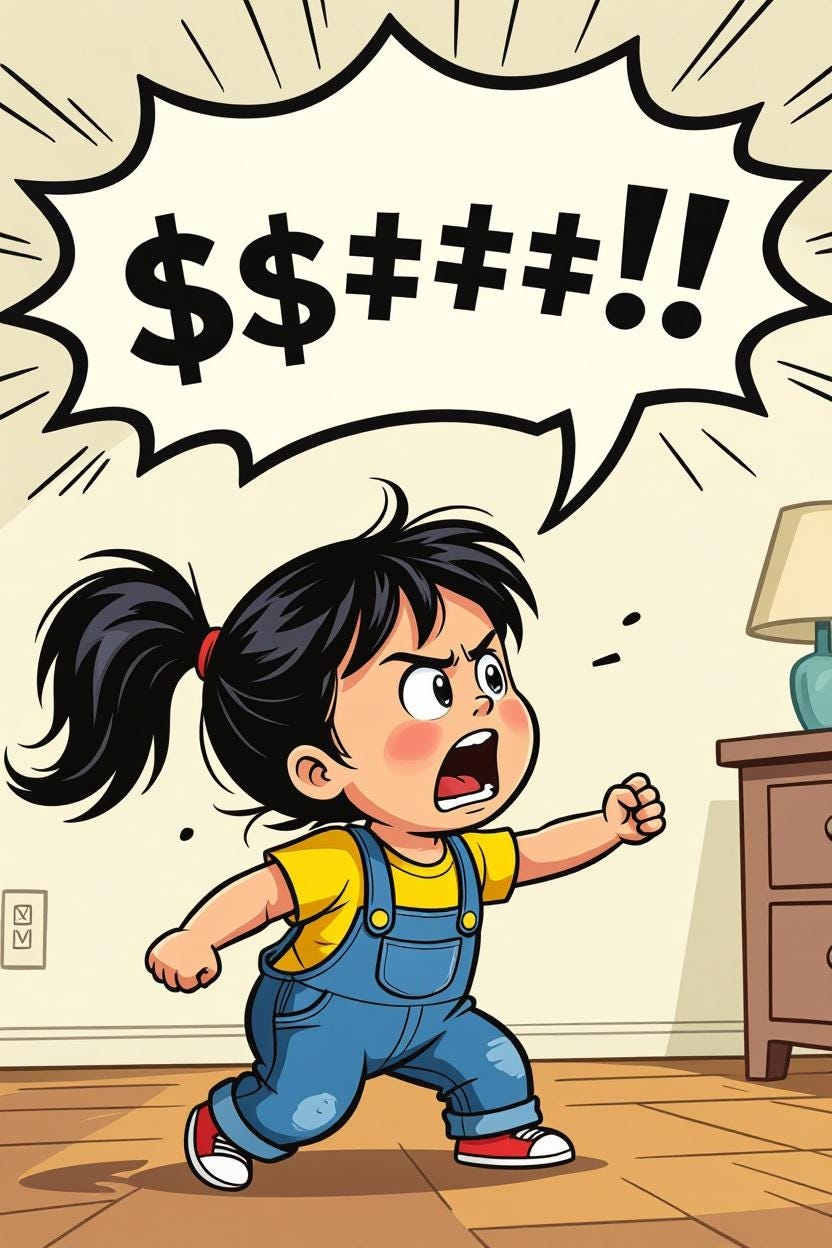
My landlord was talking with his friends, and his daughter was playing at his feet largely ignored by the adults. Just as my landlady came out to join the group, her almost two-year-old daughter, frustrated with a rock that she could not pick up, let out a loud, “Puta madre!”
Now for English speakers, these words have no impact. They are just words and fairly nice sounding words, truth be known. Not so if you are Spanish speaking. My landlady laid a round house smack across the side of her husband’s head that almost knocked him over.
“I told you to stop using such vulgar language in front of her!”
Again, if you are English speaking, you wonder what was so vulgar about the words. If you are Spanish speaking, you are offended that I included the words in this story. Why the difference in reaction? The words are the same, but the acculturation is entirely different.
The men in this little tableau all looked down shaking as they stifled their laughs while the hapless husband stood rubbing his ear and feeling decidedly confused as wife and daughter stomped back into the house. I too was a bit confused, even as I stifled my own laughter.
Many years later my language skills were sufficient that I could read novels in Spanish, and I developed a deep appreciation for one author who had a never-to-be missed weekly talk show on one of the local TV stations. His books used a great deal of “street language” but his plots were complex and very funny. In one of his books, he related the story of how the members of the family around whom the story revolved were fulfilling the last wishes of the patriarch by distributing his ashes off one of the many breakwaters along the coast of Lima. The breakwaters are built of large rocks dumped in long lines into the surf so the description of the geriatric members of this upper-class family making their way out far enough to satisfy the requirements of the deceased Raoul was very funny. When the urn was uncorked and its contents were emptied, the wind shifted and blew Raoul into everyone’s face causing his widow to spend the next two weeks furiously digging into her nose to remove all traces of her philandering husband.
At any rate, one of his books included a compendium of the vast panoply of Spanish words used to describe the sex act. As in English, these words elicit different reactions based on cultural training. I knew that in this important vocabulary was the Spanish equivalent of the “f” word. I just didn’t know which one it was.
The next day, I joined a group of gringo and Peruvian friends from the mining industry to meet with the socialist front runner in the upcoming Peruvian presidential elections. He had agreed to meet with us for 15 minutes to describe his views and proposed mining policies and hear our comments and suggestions. As we sat with his Chief of Staff waiting for the meeting to start, the conversation roamed over inconsequential items. I felt this would be a good time to address my confusion related to Spanish sexual terms. I explained my dilemma and when asked,
“What sort of words?”

I offered the full list. When three hands shot out to cover my mouth and I was told in no uncertain terms to “shush” I knew I had struck gold. I had found the “f” word.
It works in reverse as well. Upon my return to Canada, I had occasion to hire my former landlord at a mine where I worked. To perfect his English, he started out working in the field and soon had complete command of every cuss word in the English language. I found this quite funny but realized the cultural problems caused by this when he visited my home and had no clues about the impact of his language on my wife and kids. It was “f” this and “f” that until, through tears of laughter, I explained that some of his newfound vocabulary had to be stifled particularly as his wife and kids were soon to join him. I was able to explain the situation using the story of his two-year-old daughter. The light went on as he instinctively rubbed his ear.
What is the point to all this? I am old enough to be astounded at the crude language used in most films and movies today. Go into any restaurant and well-dressed men and women, in mixed company, will be using language to make a sailor blush. What is the matter with these people? Thirty years ago, I could embarrass such filthy tongues into stopping their cussing but today they just look at me quizzically.
“Hey old man, what do you mean, filthy language?”
They have been acculturated into the language of a Shakespearean comedy or a 19th century ship’s company.
If our reaction to words is culture dependent, do these words constitute filthy language or do they simply reflect a more earthy culture? If hearing them brings back the taste of soap then they are viewed as filthy language. But if you grew up in a house awash in such language then perhaps, they are today’s version of “darn” or “shucks”.
But is the coarsening of discourse, whether in the bosom of the family or the tar pit of the street, a public good? I would argue in the negative and urge that such coarse words should not be used. However, how is this change to be brought about? Culture is upstream from politics, and I would not be comfortable with a government mandating the “de-coarsening” of our language. This sounds like mandated speech, and such legislative overreach makes the cure worse than the disease. It is an unresolvable dilemma perhaps related to the emptying of churches in the past 60 or 70 years.
But maybe help is on the way. According to recent polling, Gen Z, the youngest population cohort, provides the largest number of today’s regular church attenders. I wonder how they feel about the coarsening of our words. I will have to remember to ask those mofos.
Share what you write! I will be happy to print it here if you can figure out how to get it to me.
Do you recall the most offensive bumper sticker?
“Nuke the gay whales!”
Clean language though!